Email marketing remains a useful way for businesses to communicate with customers, share updates, promote services, and build long-term relationships. However, when planning an email marketing strategy, one common question arises: should you send regular emails or create an e-newsletter?
Although the terms are sometimes used interchangeably, they serve different purposes. Regular business emails often focus on a specific person, action, or offer, while e-newsletters typically share curated updates, educational content, company news, and useful resources with a group of subscribers.
Understanding the difference between email and e-newsletter marketing can help your business choose the right communication approach, improve customer engagement, and make better use of its marketing efforts.
What Is an Email?
An email is an electronic message sent from one email address to another. Businesses use emails for sales communication, customer support, appointment confirmations, service updates, promotions, and follow-ups.
In marketing, an email can be designed to achieve one clear objective, such as encouraging a potential customer to book a consultation, explore a service, or complete a purchase.
Common Business Email Examples
- Welcome emails: Introduce your business to new subscribers or customers.
- Follow-up emails: Continue conversations with potential clients after an enquiry.
- Promotional emails: Announce discounts, special offers, or new services.
- Transactional emails: Confirm purchases, bookings, payments, or account activities.
- Sales emails: Explain how your products or services can solve a customer’s problem.
Benefits of Business Emails
Business emails allow companies to communicate directly with customers and prospects. They can be personalized according to a recipient’s interests, previous interactions, or stage in the buying journey.
For example, a website development agency can send a personalized email to a business owner who has requested a website quotation. The message can explain the recommended solution, answer questions, and suggest the next step.
This makes email useful when your goal is to start a conversation, follow up on a lead, or encourage a specific action.
What Is an E-Newsletter?
An e-newsletter, or electronic newsletter, is a recurring email communication sent to subscribers who have chosen to receive updates from a business or organization.
Unlike a one-to-one business message, an e-newsletter usually follows a consistent format and contains several pieces of useful content. It may be sent weekly, monthly, or at another frequency that suits the audience.
Common E-Newsletter Examples
- Company updates: Share business news, milestones, and announcements.
- Educational newsletters: Provide practical tips, guides, and industry insights.
- Blog roundups: Highlight recently published articles and resources.
- Product updates: Explain new features, services, or improvements.
- Curated industry news: Summarize relevant developments and useful resources.
Benefits of E-Newsletters
E-newsletters help businesses stay connected with subscribers over time. Rather than focusing only on an immediate sale, they can provide ongoing value, build brand recognition, and encourage readers to return to the business website.
For example, a digital marketing agency can send a monthly newsletter featuring SEO tips, website improvement ideas, recent blog articles, and updates about its services.
By consistently sharing relevant information, the agency can remain visible to potential customers and strengthen its relationship with existing clients.
Email vs E-Newsletter: Key Differences
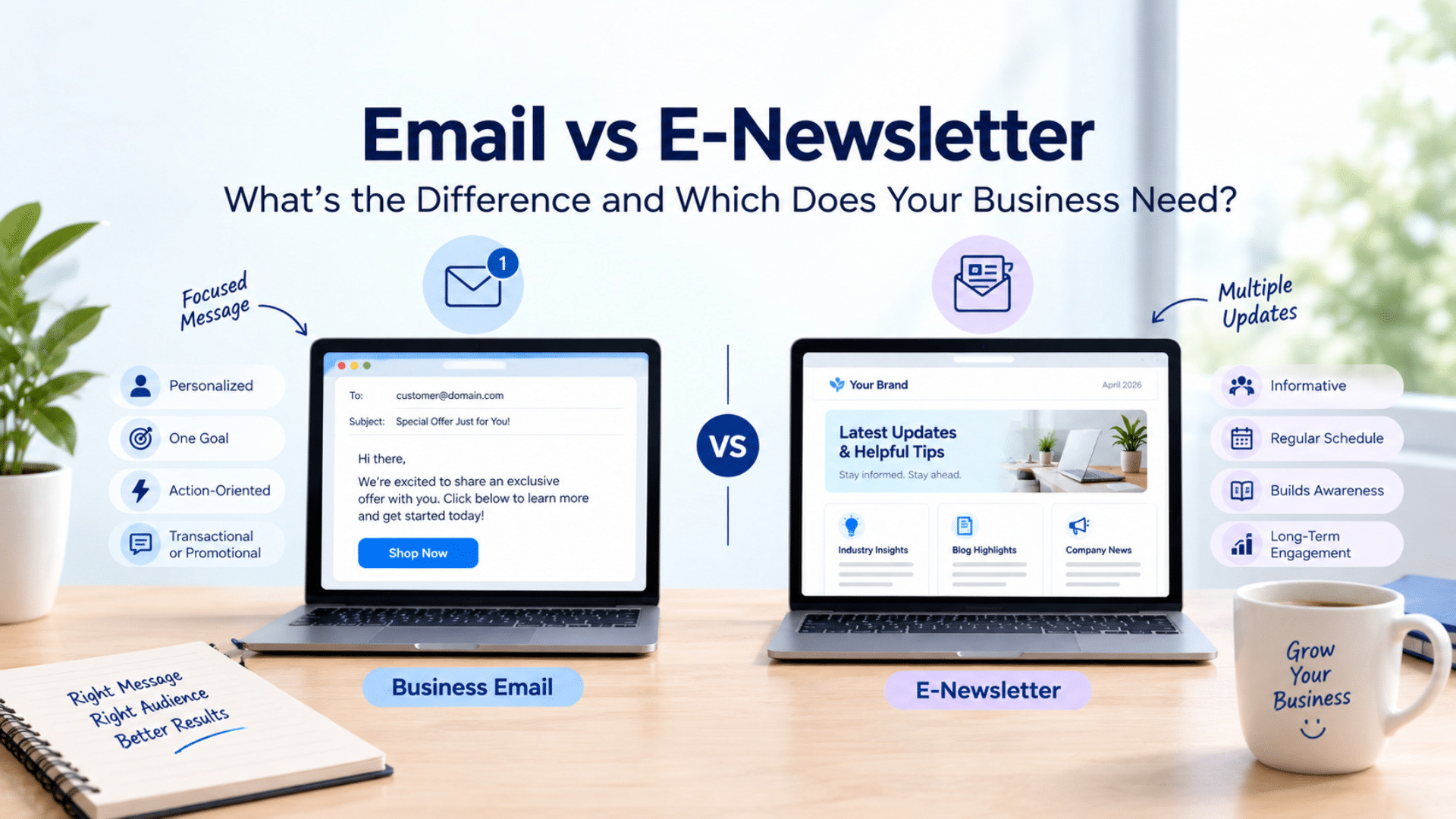
The main difference is the purpose and structure of the communication. An e-newsletter is itself a type of email, but not every email is an e-newsletter.
| Feature | Business Email | E-Newsletter |
|---|---|---|
| Main purpose | Achieve a specific communication goal | Share regular updates and useful content |
| Content | Usually focused on one topic or action | Often includes multiple articles or updates |
| Personalization | Can be highly personalized | Often sent to a subscriber segment |
| Frequency | Sent when a need arises or a campaign runs | Usually follows a regular schedule |
| Design | Plain text or branded design | Commonly uses a consistent branded template |
| Call to action | Often one primary action | May include several relevant links |
| Best use | Follow-ups, offers, enquiries, confirmations | Education, updates, relationship building |
Both formats can support business growth. The right choice depends on what you want recipients to do and the kind of relationship you want to build with them.
Which Does Your Business Need?
You do not necessarily have to choose just one. Many businesses use regular emails and e-newsletters together as part of a broader communication strategy.
Choose Business Emails If You Want to:
1. Generate and Follow Up on Leads
If someone contacts your business for pricing or service information, a personalized email can answer their questions and guide them toward the next step.
2. Promote a Specific Offer
When launching a service or announcing a limited-time offer, a focused promotional email can communicate the details and direct readers to the relevant page.
3. Improve Customer Communication
Emails are useful for sharing quotations, project updates, appointment details, and other information related to a customer’s interaction with your business.
Choose an E-Newsletter If You Want to:
1. Build Long-Term Customer Relationships
Regular, helpful content keeps your business connected with subscribers even when they are not ready to buy immediately.
2. Increase Website Traffic
You can include links to blog posts, service pages, case studies, and useful resources to encourage readers to explore your website.
3. Establish Industry Expertise
Sharing educational content and practical insights can demonstrate your knowledge and help readers understand how your business can support their needs.
4. Keep Your Audience Informed
A newsletter provides a consistent place to share company announcements, new services, upcoming events, and relevant industry updates.
How to Use Email and E-Newsletters Together
A balanced strategy uses each format for the purpose it serves best. Start by identifying your audience, the information they need, and the action you want them to take.
Here is a simple approach:
Step 1: Build a permission-based contact list. Collect email addresses through enquiry forms, newsletter subscriptions, or other appropriate opt-in methods. Do not assume that every contact has agreed to receive marketing messages.
Step 2: Segment your audience. Separate subscribers, potential customers, and existing clients where relevant. This helps you send more useful and appropriate messages.
Step 3: Use focused emails for specific actions. Send relevant follow-ups after enquiries, share quotations, and communicate important customer updates.
Step 4: Create a useful newsletter. Share educational articles, company news, helpful tips, and links to relevant resources. Avoid making every edition a sales pitch.
Step 5: Measure performance. Track appropriate metrics such as clicks, conversions, unsubscribes, and website visits. Use the results to improve your content and timing.
Google’s email subscription guidelines explain important practices for subscription messages, including unsubscribe handling and list management. Always follow applicable privacy and marketing rules for your audience’s location.
Best Practices for Effective Email Marketing
Whether you send individual business emails or recurring newsletters, a few principles can improve the experience for your recipients.
- Write clear subject lines: Explain what the message contains without misleading the reader.
- Provide useful content: Make each message relevant to the recipient’s needs.
- Use a mobile-friendly design: Ensure the message is readable on phones, tablets, and desktops.
- Keep your branding consistent: Use recognizable business details, colors, and formatting.
- Include clear calls to action: Make the next step easy to understand.
- Respect subscriber preferences: Send marketing messages to appropriate recipients and provide a simple unsubscribe option where required.
- Review performance regularly: Test subject lines, content, and sending frequency to understand what works for your audience.
For additional guidance, see Google’s bulk email best practices.
Common Mistakes to Avoid
Even a well-designed email campaign may perform poorly if the content does not match the audience’s expectations.
Avoid sending the same promotional message repeatedly, adding people to marketing lists without appropriate permission, using misleading subject lines, or sending newsletters without a clear purpose.
You should also avoid measuring success only by email opens. Clicks, meaningful enquiries, conversions, and subscriber retention can provide a more useful picture of how your communication supports business goals.
Most importantly, focus on relevance and consistency rather than sending messages simply to maintain a schedule.
Final Thoughts
Email and e-newsletters serve different but complementary purposes. Business emails are particularly useful for focused communication, lead follow-ups, promotions, and customer updates. E-newsletters are better suited to sharing ongoing information, educating subscribers, and building long-term relationships.
For many businesses, the strongest approach is to use both strategically: send focused emails when a specific action is needed, and publish a newsletter when you have genuinely useful updates to share.
At SEO WEB Technology, we help businesses strengthen their online presence through website development, SEO, and digital marketing services. Explore our digital marketing services to learn how a coordinated online strategy can support your business goals.
Ready to improve your digital communication and grow your online presence? Contact SEO WEB Technology to discuss your business needs.