Introduction
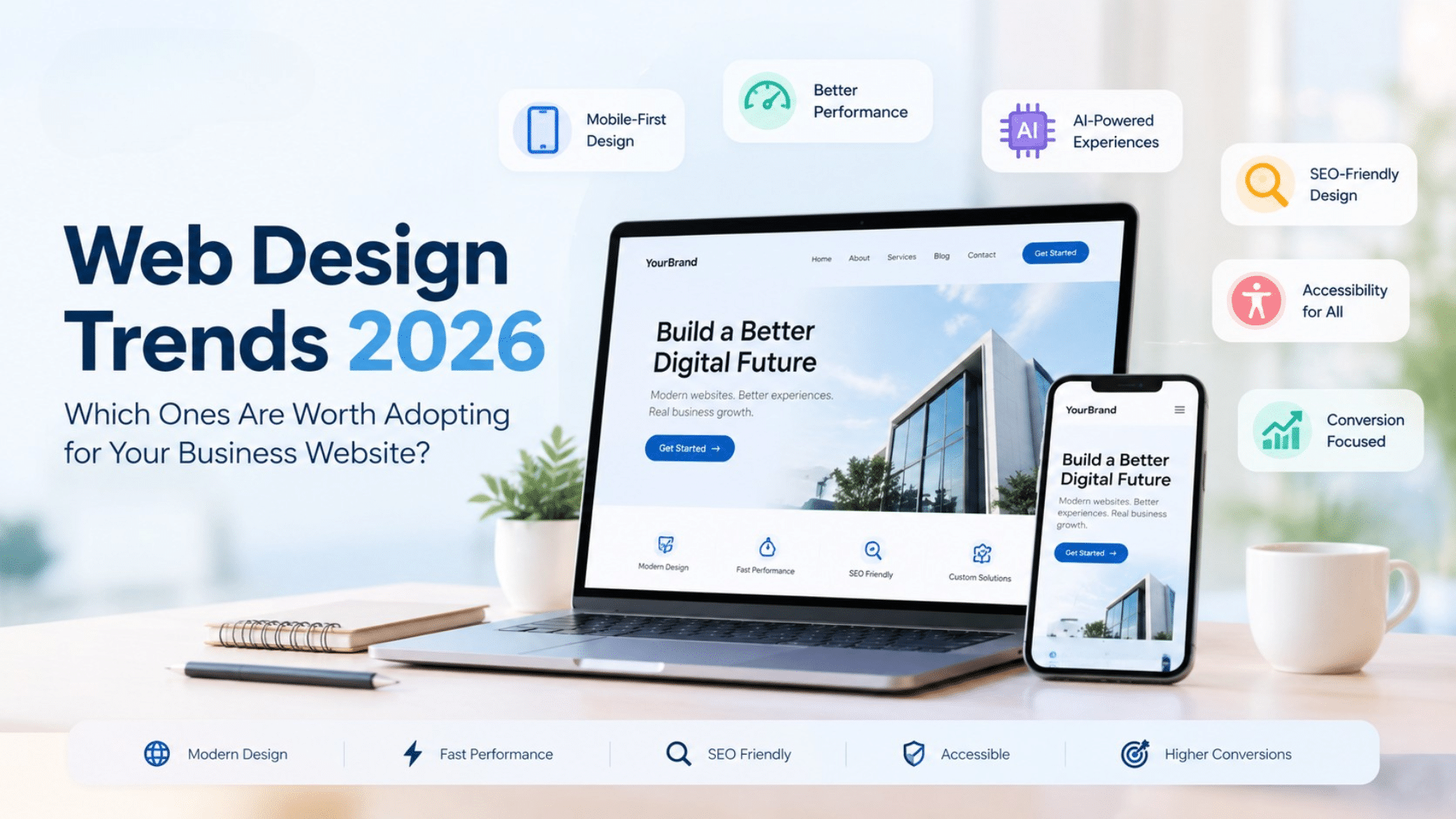
Website design is changing quickly in 2026. Businesses are moving away from websites that simply “look good” and toward websites that are fast, easy to use, accessible, search-friendly, and focused on conversions.
New design styles such as AI-assisted experiences, immersive visuals, micro-interactions, minimal layouts, and interactive elements are becoming more common. But not every trend is worth adding to a business website.
The real question is:
Which web design trends in 2026 can actually improve your website and help your business grow?
In this guide, we’ll look at the most useful website design trends 2026 and explain which ones businesses should consider adopting.
1. Clean and Minimal Website Design
Minimalism continues to be one of the strongest modern web design trends in 2026.
Instead of filling every section with text, icons, animations and graphics, businesses are focusing on:
- Clear headlines
- More white space
- Simple navigation
- Strong visual hierarchy
- Focused calls-to-action
- Easy-to-understand content
A clean design helps visitors understand your business faster and makes important information easier to find.
For example, your homepage should quickly answer three questions:
What do you offer? Who do you serve? Why should customers choose you?
If visitors cannot understand these within a few seconds, even a beautiful website can lose potential customers.
2. Performance-First Web Design
One of the biggest website design trends 2026 is designing for performance from the beginning.
A website should not sacrifice speed just to add impressive animations or large visual elements.
Google recommends looking at the overall page experience, including mobile usability, security, Core Web Vitals and whether the main content is easy to distinguish and use.
Businesses should therefore focus on:
- Optimized images
- Lightweight code
- Fast hosting
- Lazy loading
- Efficient fonts
- Fewer unnecessary scripts
- Mobile performance
A faster website can create a smoother experience and reduce the chances of visitors leaving before they even see your offer.
3. Mobile-First Website Design
Your website needs to work exceptionally well on smartphones.
Mobile-first design means designing the experience around smaller screens first and then expanding it for tablets and desktops.
Important elements include:
- Easy-to-read text
- Large, touch-friendly buttons
- Simple navigation
- Properly sized images
- Fast-loading pages
- Easy-to-use forms
A website that looks perfect on desktop but becomes difficult to navigate on mobile is not delivering a modern user experience.
4. Subtle Micro-Interactions
Animations are becoming smarter and more purposeful.
Instead of excessive motion everywhere, modern websites are using micro-interactions—small visual responses that help users understand what is happening.
Examples include:
- Button hover effects
- Smooth scrolling
- Form validation feedback
- Animated icons
- Progress indicators
- Subtle transitions
The key is moderation.
Animation should support usability, not distract visitors from the content.
5. AI-Powered Website Experiences
AI is influencing website design beyond content generation.
Businesses can increasingly use AI to create more personalized and useful website experiences, such as:
- AI chat assistants
- Personalized recommendations
- Smart search
- Automated customer support
- Conversational interfaces
- Dynamic content experiences
However, AI should solve a real customer problem.
Adding an AI chatbot simply because it is trendy may not improve your website. The better approach is to identify where customers need help and use AI where it genuinely makes the journey easier.
6. More Human and Authentic Visuals
Stock images are no longer the only option for professional website design.
Businesses are increasingly using:
- Original photography
- Real team images
- Product demonstrations
- Behind-the-scenes visuals
- Customer stories
- Authentic videos
This can make a website feel more trustworthy and relatable.
For service businesses especially, showing the real people behind the business can help potential customers feel more confident before making an enquiry.
7. Interactive and Immersive Elements
Interactive design can make a website more memorable.
Depending on the business, this could include:
- Interactive product previews
- Before-and-after sliders
- Scroll-based storytelling
- Interactive calculators
- Product configurators
- 3D product views
But there is an important rule:
Interaction should have a purpose.
If an animation makes the website slower or makes navigation confusing, it is probably not worth adding.
The best interactive features help visitors understand a product, service or process more easily.
8. Accessibility as a Core Design Principle
Accessibility is becoming an increasingly important part of modern website design.
Instead of treating accessibility as something to check after the website is finished, businesses should consider it during the design and development process.
Good practices include:
- Readable font sizes
- Strong color contrast
- Descriptive link text
- Keyboard-friendly navigation
- Proper form labels
- Meaningful image alt text
- Clear content structure
Accessibility improvements can also make websites easier to use for everyone—not just users with disabilities. Current web-design discussions increasingly treat accessibility as a design principle rather than a final checklist.
9. SEO-Friendly Website Design
A beautiful website is not useful if potential customers cannot find it.
In 2026, website design and SEO should work together.
An SEO-friendly website should have:
- Clear page structure
- Descriptive headings
- Crawlable navigation
- Mobile-friendly layouts
- Fast performance
- Optimized images
- Internal linking
- Clear and useful content
- Strong technical foundations
Google continues to emphasize people-first content and good page experience rather than designing pages purely to manipulate search rankings.
Visual content is also becoming more important as search becomes more multimodal. Google introduced new Search Console reporting for searches involving Lens, Circle to Search, image uploads and “Search this image” in September 2026.
That makes properly optimized images and useful visual content increasingly valuable.
10. Conversion-Focused Website Design
Perhaps the most important trend is not really a visual trend at all.
It is conversion-focused design.
A business website should guide visitors toward the next step.
Depending on your business, that could be:
Call Now → Get a Quote → Book a Consultation → Send an Enquiry → Buy Now
A conversion-focused website uses:
- Clear CTAs
- Trust signals
- Testimonials
- Reviews
- Service benefits
- Simple enquiry forms
- Relevant landing pages
- Easy contact options
The goal isn’t simply to generate more website visitors.
The goal is to turn relevant visitors into customers.
Which Web Design Trends Should Your Business Adopt?
Not every business needs every trend.
A better approach is to prioritize trends based on your business goals.
If your website is outdated:
Focus on modern layouts, mobile-first design and better navigation.
If your website is slow:
Focus on performance, image optimization and technical improvements.
If you get traffic but few enquiries:
Focus on conversion-focused design, CTAs, trust signals and clearer messaging.
If you’re struggling with Google visibility:
Focus on SEO-friendly architecture, useful content, performance and technical SEO.
If you sell products online:
Consider interactive product experiences, personalization and smarter search.
What Web Design Trends Should You Avoid?
Trends are useful, but blindly following them can hurt your website.
Avoid:
- Excessive animations
- Slow-loading videos
- Complicated navigation
- Too many pop-ups
- Tiny text
- Low-contrast designs
- Auto-playing audio
- Decorative elements with no purpose
- Design that looks impressive but makes conversion difficult
The best website isn’t necessarily the most visually complicated one.
It is the one that helps visitors find information, trust your business and take action.