
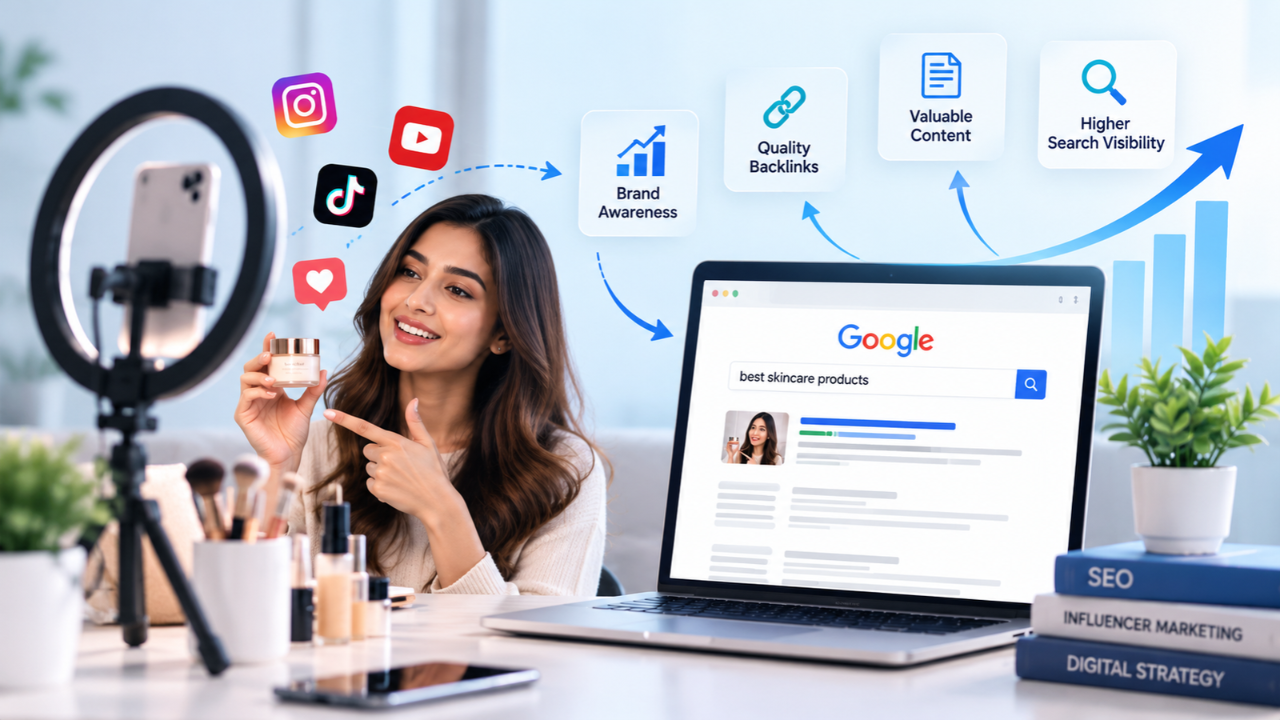
Influencer marketing and Search Engine Optimization (SEO) are often treated as separate digital marketing strategies. Influencer marketing helps brands reach new audiences through trusted creators, while SEO focuses on improving a website’s visibility in search engines. However, when these strategies work together, they can support brand awareness, content discovery, and long-term online visibility.
Today, consumers frequently discover products and services through social media creators before searching for them on Google. A useful creator review, tutorial, or product recommendation may encourage people to research a brand, visit its website, or search for its products later.
Although influencer marketing does not directly guarantee higher Google rankings, it can support SEO through relevant website visits, brand awareness, content opportunities, and naturally earned links.
In this guide, we will explore how businesses can combine influencer marketing and SEO to strengthen their digital presence.
1. Understanding the Connection Between Influencer Marketing and SEO
Influencer marketing involves collaborating with creators who have an engaged audience in a specific niche. These creators may publish product reviews, demonstrations, tutorials, travel experiences, or educational content.
SEO helps websites appear in relevant search results by improving content quality, website structure, technical performance, and relevance to user searches.
The connection becomes valuable when influencer content encourages audiences to discover and explore a brand beyond social media.
For example, a skincare brand may collaborate with a beauty creator who publishes a product routine. Interested viewers might search for the brand on Google, read ingredient information, and visit the company’s website.
Similarly, a travel company may work with a travel creator whose destination video inspires viewers to search for tour packages and travel guides.
The key idea: Influencer marketing can create discovery opportunities, while SEO helps your website capture relevant search interest.
2. Build Brand Awareness That Supports Search Discovery
One benefit of influencer marketing is introducing your business to people who may not have discovered it through traditional search results.
When creators explain a product or service in a relatable way, their audiences may become curious about the brand and search for additional information.
Businesses can support this journey by maintaining a clear and useful website.
For example, after a creator features a digital marketing agency, potential customers may search for its name, review its services, and explore its case studies.
To make the most of this opportunity:
- Keep your brand name and website information consistent.
- Create clear service and product pages.
- Publish useful answers to common customer questions.
- Make contact details easy to find.
- Monitor branded search queries in Google Search Console.
An increase in branded searches can indicate growing awareness, although it does not automatically mean that overall rankings will improve.
3. Create SEO-Friendly Content With Influencers
Influencer collaborations can generate ideas and material for content that serves both social media audiences and website visitors.
Instead of limiting a partnership to one social media post, consider how the creator’s expertise can support a broader content strategy.
For example, a fitness brand could collaborate with a fitness creator to produce a workout demonstration. The brand could then develop a related website article covering exercise techniques, beginner tips, and common mistakes.
Other useful formats include:
- Product reviews and comparisons.
- Expert interviews.
- Step-by-step tutorials.
- Frequently asked questions.
- Destination guides and travel experiences.
- Case studies based on genuine customer experiences.
Make sure website content provides additional value rather than simply copying a creator’s social media caption.
Use relevant keywords naturally, organize information with clear headings, and link to related pages where appropriate. Always obtain permission before republishing creator videos, images, or written content.
4. Earn Relevant Backlinks Through Creator Partnerships
Backlinks are links from other websites that point to your website. Relevant, naturally earned backlinks can help search engines discover pages and understand their connections to other resources.
Influencer partnerships may create opportunities for these links when creators publish content on their own websites or contribute to relevant online publications.
For example, a travel blogger might link to a tour operator’s detailed destination guide, or a technology creator might reference a software company’s tutorial.
To encourage legitimate link opportunities:
- Collaborate with creators who maintain relevant websites or blogs.
- Offer useful resources that genuinely support their content.
- Share original research, guides, or expert insights.
- Build long-term relationships instead of focusing only on link placement.
Avoid buying links or requiring creators to place links solely to manipulate search rankings. Paid collaborations should be disclosed appropriately, and links should follow applicable search engine guidelines, including the use of rel="sponsored" where appropriate.
Important: A creator mentioning your brand does not automatically produce a backlink, and not every backlink will improve rankings.
5. Use Influencer Content to Understand Customer Search Intent
Creators often receive questions directly from their audiences. These questions can reveal what customers want to know before making a purchase or choosing a service.
This information can help businesses identify useful SEO topics.
For example, comments on a travel creator’s video may include questions about package prices, hotel options, transport, and the best time to visit a destination.
A travel company can turn these questions into helpful website content, such as:
- How Much Does a Rajasthan Tour Cost?
- What Is Included in a Guided Tour Package?
- Best Time to Visit Rajasthan.
- How to Choose the Right Family Holiday Package.
Before publishing, research relevant search terms and check whether people are searching for similar information on Google.
This approach helps businesses create content based on real audience interests instead of relying entirely on assumptions.
6. Repurpose Creator Content Across Digital Channels
A successful influencer collaboration can provide several content opportunities, provided the brand has permission to reuse the material.
For example, a creator’s product demonstration could become a website article, a short video on the brand’s website, a social media post, or a section in a relevant product guide.
Repurposing content can help maintain consistent messaging across channels and give potential customers multiple ways to discover your business.
However, each format should serve its audience. A website article should offer useful context, while a short social media video should communicate its message quickly.
Avoid publishing duplicate or thin pages simply to distribute the same content across multiple URLs. Focus on making every website page useful and distinct.
7. Measure the Results of Influencer Marketing and SEO Together
Businesses should measure both marketing performance and search visibility to understand whether their combined strategy is delivering value.
Useful metrics include:
- Organic clicks and impressions: Track search performance through Google Search Console.
- Branded search activity: Monitor changes in searches for your business name.
- Referral traffic: Use analytics tools to identify visits from creator websites and campaign links.
- Conversions: Measure enquiries, purchases, bookings, or other business goals.
- Content engagement: Review how visitors interact with pages supported by influencer campaigns.
- Backlink quality: Assess whether relevant websites are linking to useful content.
Use campaign-specific UTM parameters for trackable links where appropriate. Compare performance before, during, and after campaigns, while remembering that several factors may influence search traffic.
Influencer campaigns can contribute to awareness and discovery, but it is difficult to attribute every later search or sale to a single creator.
8. Choose the Right Influencers for Your SEO Goals
The largest audience is not always the best choice. Businesses should prioritize relevance, audience quality, credibility, and the creator’s ability to explain their offering clearly.
Before selecting a creator, consider:
- Whether their audience matches your target customers.
- Whether their content fits your industry.
- Whether their engagement appears genuine.
- Whether they communicate accurately and transparently.
- Whether the collaboration supports a clear business objective.
For example, a local healthcare business may benefit more from a relevant healthcare educator than from a general lifestyle creator with a much larger but less relevant audience.
Set clear expectations, agree on content usage rights, disclose sponsored partnerships, and evaluate performance using meaningful metrics.
Conclusion
Influencer marketing and SEO can complement each other when businesses focus on useful content, relevant audiences, and a consistent online experience. Creator partnerships can introduce brands to new audiences, reveal customer questions, and create opportunities for website visits and naturally earned links.
For the best results, combine influencer collaborations with strong website content, sound technical SEO, and regular performance tracking. Avoid expecting instant rankings; focus instead on building visibility and trust over time.


